Project Overview
 Project Overview
The L&D team of a multinational retail company
Learning Experience Designer, Project Manager, and People Manager — leading design and the internal delivery team
30 emerging leaders building leadership and interpersonal skills
L&D team, coaches, senior executives
Blended — online & in-person sessions across a 6-month journey
Rated 4.6/5 for relevance & engagement, 30 leaders impacted, actionable business ideas approved for implementation
"How might we design a program for emerging leaders that combines practical problem-solving with leadership and personal development, enabling them to apply innovative thinking to real business challenges?"
Learning Needs & Insights
 Learning Needs & Insights
Thirty learners needed a program that combined practical problem-solving with leadership and personal development skills, enabling them to apply innovative thinking to real business challenges.
Research identified three core requirements:
- Hands-on experience applying innovative thinking to real-world problems
- Development in soft skills such as critical thinking, personal branding, and conflict resolution
- Structured guidance through collaborative, team-based problem-solving
Learning Objectives
 Learning Objectives
The program was anchored to a clear set of outcomes the emerging leaders needed to be able to demonstrate by the end of the journey.
By program completion, learners needed the ability to:
- Apply Design Thinking to real business challenges to generate actionable solutions
- Collaborate effectively within teams, leveraging interpersonal and leadership skills
- Present and advocate for solutions to senior stakeholders with confidence
Learning Strategy & Content Alignment
 Learning Strategy & Content Alignment
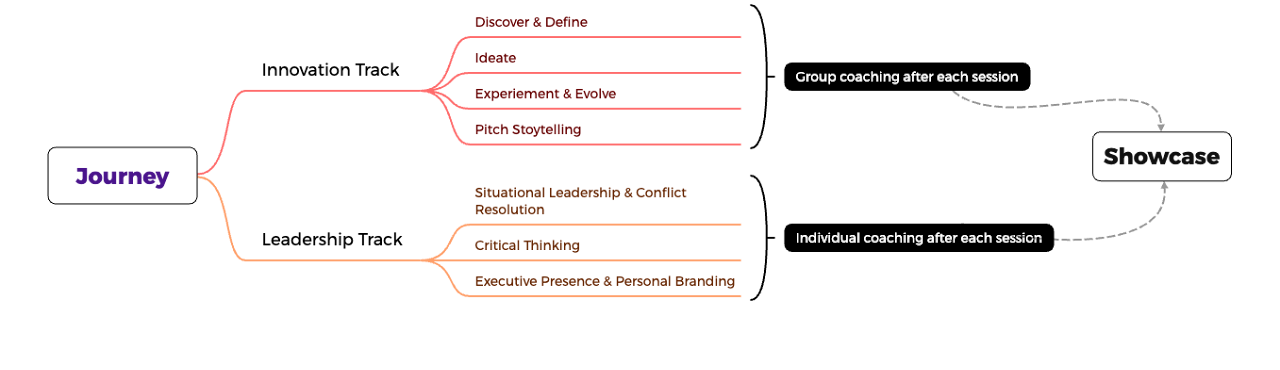
To hold both the practical and the personal-development goals at once, I designed the program around a dual-track structure, supported by team projects, coaching, and a blended delivery approach.
A dual-track program
The Innovation Track focused on Design Thinking methodology, problem-solving, and ideation — giving learners a repeatable approach to tackle real business challenges.
The Leadership Track built soft skills including critical thinking, personal branding, and conflict resolution — the interpersonal foundations emerging leaders needed to influence and collaborate.
The two tracks were tied together through team-based projects, dedicated coaching support, and a blended delivery approach that combined online and in-person sessions.
Learners didn't just study leadership — they practised it on real business problems, with coaches alongside them.
Learning Architecture & My Role
 Learning Architecture & My Role
As Learning Experience Designer, Project Manager, and People Manager, I owned the experience design and led the internal team delivering it.
My responsibilities encompassed:
- Session topic mapping and sequencing across both tracks
- Learner research for needs assessment
- Session content and facilitator guide creation
- Facilitator management and support
- Internal delivery team leadership
- Assessment and reflection activity design
Impact
 Impact
Learners generated actionable business ideas, some of which were approved for implementation, and high engagement was maintained across both learning tracks.
What I'd take forward
 What I'd take forward
The dual-track structure was the decision that made everything else work. Leadership skills practised in a vacuum rarely stick; pairing them with a live innovation challenge gave learners an immediate place to apply what they were developing.
Wearing three hats — designer, project manager, and people manager — meant the experience on the page and the experience in the room had to stay in sync. Leading the delivery team directly kept the design honest.
The strongest signal wasn't the 4.6/5 rating — it was that the leaders' ideas were good enough to be approved for implementation. Experiential learning works best when the "experience" is real.